Research Snapshots
This website presents the output of the DFG-funded project “Gambian Returnees as Producers of Knowledge on the Border Regime”, which examined how Gambians with experience of migration through North Africa and Europe understand, navigate, and contest the conditions governing their mobility. It analysed the connections between restrictive European visa policies, border externalisation, violence and detention in Libya, asylum and forced-repatriation procedures in Europe, and return and reintegration initiatives in The Gambia.
Through collaborative ethnographic research with members of Youth Against Irregular Migration (YAIM), a returnee-led Gambian advocacy organisation, the project treated returnees not only as recipients of migration policy but as producers of knowledge about the institutions and unequal mobility regimes shaping their lives.
The collaboration with YAIM was born on the premises that the organisation had already developed its own activities, vision, and advocacy work on migration. YAIM members had reflected on and articulated their experiences over several years, sharing their analysis in villages, communities, and radio programmes.
During the first period, we negotiated the terms of the collaboration and agreed on the medium and topics of the podcast. This format could reach a broad audience and drew on YAIM members’ experience of producing migration-related radio programmes in The Gambia since 2018.
In the course of three and a half years, we recorded twelve focus-group discussions of three to four hours each in preparations of the recordings; podcast production then took place across nine recording sessions of two hours each, while collective editing was carried on in 8 sessions of 2 hours each. In April 2026, two dissemination sessions were conducted to decide how to broaden outreach. The seven core YAIM members who participated were remunerated for their work in developing, recording, and editing the podcast.
Viola travelled with YAIM across the country on several occasions, observing its work and the challenges faced by young Gambians and their families in urban and rural settings. When Viola was not in The Gambia, communication and collaborative work continued remotely through a dedicated WhatsApp group, collective online calls and the precious coordination of YAIM President Saikou Tunkara.
For two years, the Backway to Europe project developed through collective conversations with YAIM members, tracing different stages of their journeys and discussing experiences of obstruction, structural violence, and technologies of containment.
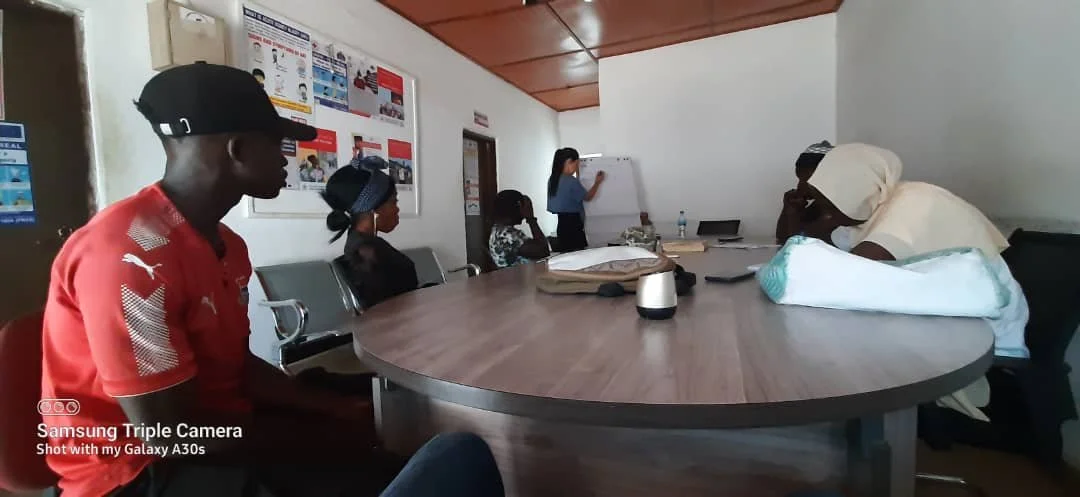
In this image, Viola sketches as YAIM members recount their experiences. The drawings became a visual record that supported collective reflection and analysis.

An IOM placquard commemorating the December 2019 shipwreck off the coast of Nouadhibou, Mauritania.
The boat had departed from The Gambia and was bound for the Canary Islands, carrying an estimated 150 to 200 people.
It sank after developing problems at sea; IOM reported 78 Gambian survivors and nine Senegalese survivors, while 62 people were reported dead.
The notice is displayed near Westfield Roundabout in Serrekunda, one of the busiest urban areas in The Gambia.

Motivational posters produced by the Tekki Fii initiative, a programme funded through the European Union Emergency Trust Fund for Africa. Tekki Fii aimed to stop irregularized migration by improving employment and income opportunities for Gambian youth, including returning migrants, through training, entrepreneurship, employment support, and access to finance. Its messaging encouraged young people to imagine a future in The Gambia; it also reached people returning through IOM-supported voluntary return and reintegration programmes.

During visits to the Upper River Region, YAIM members meet young people and local communities to discuss everyday survival, employment, migration, and the consequences of the “backway.” Viola accompanied YAIM on several of these visits, observing conversations in which participants recognised both the profound human and social costs of the journey and the difficulty many face in meeting their own and their families’ basic needs through local work.

A room in a disused school building, now used as a community health centre in a village in the Upper River Region. YAIM temporarily transformed the space into a screening room. One of the group’s sensitisation tools was a documentary on Libya’s detention system, including distressing testimonies and images of people held in detention centres. Screenings were followed by collective discussions on restrictive visa regimes, resource extraction, government accountability, and the limited opportunities available to young people.

After a discussion with YAIM members, village chiefs, imams, farmers, and young residents, young girls play a tabletop game designed to support English learning. YAIM also organised football matches and tournaments as ways to engage young people and strengthen community ties. These activities reflect the mission of Football for a New Tomorrow, a Danish organisation that has financially supported YAIM’s work since 2021.

A billboard for Him & Her Fashion Shop, a business supported by Empretec-Gambia and GIEPA, two Gambian training and business-support organisations that partnered with UNDP and participated in the Tekki Fii programme. The billboard’s language of “modifying behaviours for sustainable business growth” reflects a development approach centred on individual entrepreneurship - an approach that Backway to Europe examines in relation to the externalisation of European border policy through development initiatives.

YAIM members prepare ataya during a workshop break. Ataya is a strong, sweet green tea commonly shared throughout the day and associated with socialising, rest, and reconnection. Prepared in homes, public spaces, and workplaces, it often accompanies conversations among friends and family as well as pauses during collective work.

A gathering on Senegambia Beach marking the end of the first phase of the project. Over three months, we held 12 extended collective discussions, tracing members’ journeys, discussing Libya’s detention system, and examining the roles of institutions such as IOM and cooperation agencies involved in return and reintegration programmes.

Credits : Clara Marnette
The collaboration with YAIM generated an unforeseen legal-accountability dimension. Systematic discussions during the research and podcast process established that some YAIM members had been detained at Mitiga prison in Tripoli in 2017. After the ICC-mandated arrest of Khaled Mohamed Ali El Hishri in July 2025 - a Libyan officer and RADA militia member who co-directed Mitiga prison from 2015 to 2020 - Viola informed YAIM about the possibility of victim participation in ICC proceedings. From November 2025, and in collaboration with the European
Center for Constitutional and Human Rights (ECCHR), Viola supported three YAIM members and, where relevant, their family members, with communication and access to information concerning victim registration procedures, formalized by ECCHR. On 16 July 2026, ICC Pre-Trial Chamber I unanimously confirmed charges of crimes against humanity and war crimes against El Hishri and committed him to trial. In this image, activists from Refugees in Libya - a self-organised collective of people on the move - hold a banner outside the ICC during the confirmation-of-charges hearing. The banner calls attention to European complicity in Libya’s system of migrant detention. Viola has been part of the Alliance with Refugees in Libya since 2024.
YAIM members prepare ataya during a workshop break. Ataya is a strong, sweet green tea commonly shared throughout the day and associated with socialising, rest, and reconnection. Prepared in homes, public spaces, and workplaces, it often accompanies conversations among friends and family as well as pauses during collective work.